
Product and architecture case study
Isiforecast
A forecasting and supply planning platform designed to turn historical sales data into concrete decisions on stock, promotions and procurement.
The product connects forecasting to real supply workflows: promotions, lifecycle, disruptions, ordering, and planning, with an architecture built to stay usable as business scope evolves.
Overview
Context
B2B client project for a logistics consulting firm serving companies with retail-oriented planning needs.
Timeline
March 2025 - present
Stack
Docker · Python · PyTorch · SQL
Published
September 2024
My role
Lead Full-Stack & ML Engineer
I led the project end to end, from architecture to business workflows. When the initial academic collaboration on the computation side did not have time to reach a usable preproduction outcome, I took over the forecasting layer design and restructured the product around a more robust architecture.
Key responsibilities
- Defined the architecture and the main technical decisions
- Built backend APIs and business-rule handling
- Integrated forecasting systems and redesigned the computation server
- Developed frontend workflows for real supply and planning use cases
- Set up infrastructure, deployment, and reliability foundations
- Helped clarify client requirements and product framing
Proof points
Architecture
React frontend, Django backend, and dedicated forecasting microservice
Business scope
Forecasting, promotions, lifecycle, disruptions, and procurement planning
Maturity
Private preproduction with tests, async workflows, and dedicated environments
Team setup
- Mostly solo development
- Initial academic collaboration with partial contribution on the computation side
- Direct work with the client to refine business priorities
The problem to solve
In many retail environments, forecasting and inventory planning still rely on spreadsheets, manual exports, and fragmented tools. Even when a forecast exists, teams still have to factor in promotions, lifecycle stages, stockouts, substitute products, supplier constraints, and replenishment logic.
The real need was therefore not just to generate forecasts, but to centralize those workflows in a product that operational teams could actually use for day-to-day planning decisions.
How I structured the solution
I designed ISIFORECAST as a full-stack platform built around three layers: a React frontend for business workflows, a Django backend for orchestration and application logic, and a dedicated computation service for training and prediction.
That separation makes the forecasting layer easier to evolve while keeping the backend responsible for workflows, persistence, and business rules.
The product scope goes well beyond forecasting itself: data import, forecast review, promotions, lifecycle management, disruption handling, and decision support for stock and procurement.
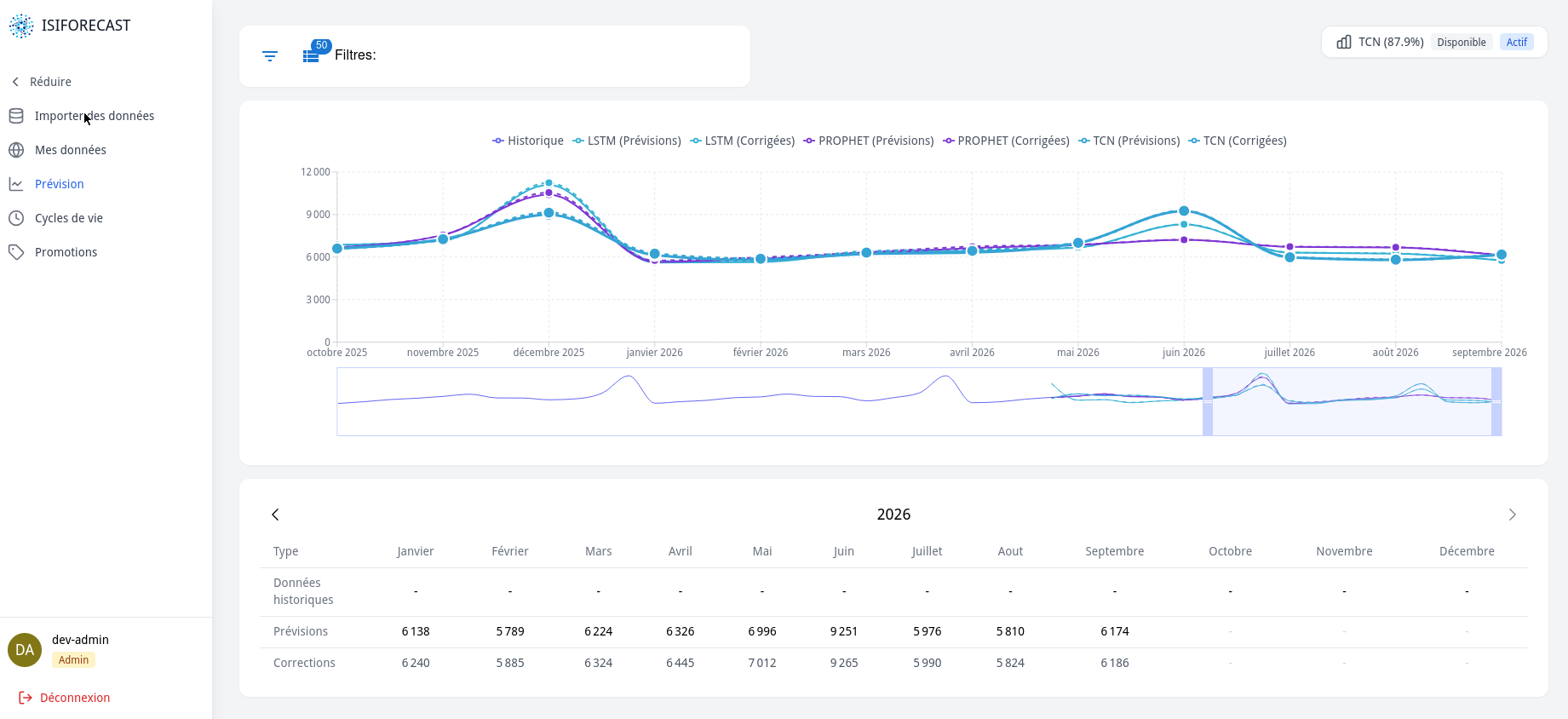
Screenshots
Challenges that shaped the project
Rebuilding the computation layer on stronger foundations
Problem
The initial work on the computation side did not have time to reach the level of quality needed for a usable preproduction product.
Solution
I redesigned the computation server, clarified the boundary between forecasting execution and application logic, and rebuilt the architecture on cleaner, more maintainable foundations.
Avoiding a forecasting-only demo
Problem
The client did not need an isolated model showcase. They needed a tool that fit real retail and supply workflows.
Solution
I expanded the platform to include promotions, lifecycle management, stock disruptions, supplier-related data, and procurement logic so forecasting would stay connected to actual operational decisions.
Showing credibility before production KPIs exist
Problem
The project is still in preproduction, so mature usage or business KPIs are not yet available.
Solution
I leaned on concrete maturity signals instead: multi-service architecture, test coverage, async workflow handling, realistic data sizes, and dedicated deployment environments.
Results and impact
- Centralized forecasting and planning workflows in a single product
- Reduced dependence on spreadsheets and manual exports
- Positioned forecasting as an operational decision-support workflow rather than a standalone model demo
- Created a clearer and more robust architecture after redesigning the computation layer
- Built credible foundations for a future production rollout
Visible proof
The environment remains private, but the project already shows credible proof through real interface captures and strong engineering maturity signals.
- Real screenshots from data, forecasting, ordering, and planning modules
- Multi-service architecture with a dedicated computation layer
- Support for databases with a few thousand SKUs
- Frontend/backend tests and async workflow handling